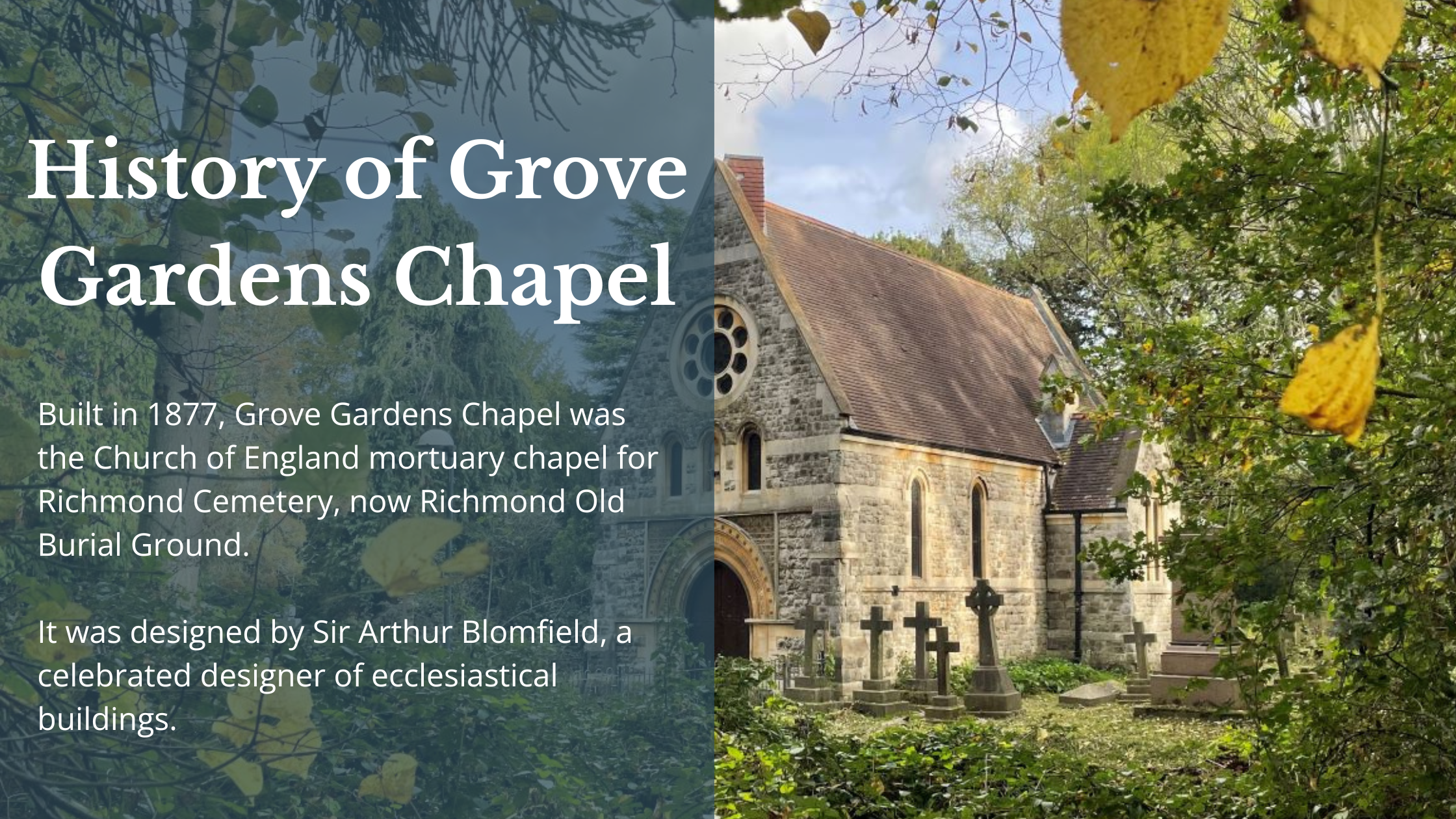
History of Grove Gardens Chapel
“the [original] chapel… was built of wood and has become unfit for use and is incapable of being satisfactorily repaired. It is proposed therefore to take down and remove the said chapel and to build a new chapel”
– Application to build the new Grove Gardens Chapel, 1876
Richmond Old Burial Ground
The “new” Richmond cemetery was proposed in the early 1850s. The churchyard of St Mary Magdalene had been full since the 1780s and was supplemented by the Vineyard Passage cemetery which, by 1850, was also reaching capacity.
The new burial ground at Grove Road initially covered 1.5 acres in the shadow of the Richmond Union Workhouse. The boundary was extended in 1873 and 1874 and two new funerary chapels – one for Anglicans and one for Nonconformists – were proposed in 1875.
Now known as Richmond Old Burial Ground, the cemetery around Grove Gardens Chapel has been closed to funerals since the 1960s.
Buying the Dead in Victorian London
The way we buried the dead in towns and cities changed dramatically in the mid-nineteenth century. London’s parish churchyards were coming under increasing pressure due to growing populations, worsening living conditions, and high death tolls caused by outbreaks of cholera and other diseases.
Before the true cause and spread of disease was understood, it was assumed that foul smells in the air, or miasma, were to blame. This was not an unreasonable assumption as increasingly crowded and dirty conditions frequently resulted in deadly public health crises.
In extreme cases, churchyards were literally overflowing. In 1839 George Alfred Walker wrote Gatherings from Grave Yards, a severe criticism of London cemeteries and his descriptions are at times stomach-turning. Graves covered by only a few inches of soil, graves dug too close to water sources such as wells and pumps, and the ground level of graveyards reaching the “first floor windows” of neighbouring houses were just some of the examples he gave. The situation had become unsustainable.
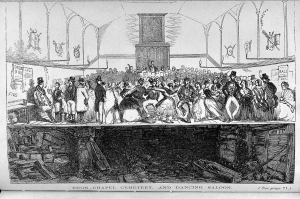
Walker’s work led to official parliamentary commissions resulting in three reports between 1840 and 1843 detailing the conditions of graveyards and recommendations for urgent reform.
A series of Acts of Parliament were enacted in the 1850s that permitted the closure of churchyards, restricted the locations of new burial grounds to the outskirts of towns, and the establishment of local Burial Boards. These measures sought to improve what Walker had described as “a national evil”.
A New Burial Ground for Richmond
While life in Victorian Richmond was a far cry from the conditions observed in the heart of the metropolis, this context would have been central to the discussions around Richmond’s newest burial ground.
The original chapels were built by public subscription in the 1850s and in the 1870s the cemetery was extended to cover 3.8 acres.
In 1874, Richmond cemetery made it to national news when the vicar ordered a wall to be built between the Anglican and Nonconformist sides of the cemetery. This wall was not on any of the plans agreed by the committee who were frustrated to find out about it after the foundations were already laid.
This physical division between Anglicans and Nonconformists was not popular in the press. A Nonconformist paper called it a “scandal” that showed the “intolerance of the vicar”. Former Prime Minister Lord John Russell condemned the wall stating that it would “drive away peace and good will between the Christians who conform to the Church, and the Christians who are Nonconformists”.
Another objector pointed out the inconvenience to Nonconformists burying their dead in vaults in the old section. If the wall remained, the funeral party would be required to leave their chapel, exit the cemetery to the public road, then re-enter the old section.
On 24th March 1874, 280 feet of the wall was destroyed overnight by some unknown persons “with the aid of crowbars and, other expeditious implements”. As one paper put it: “the dwarf wall of separation, which, in some mysterious way, fell during the night (although no earthquake or other disturbance was observed in the neighbourhood)”. Two days later, the vicar ordered the wall to be rebuilt and debate ensued.
By mid-April, the vicar conceded that the wall would be removed.
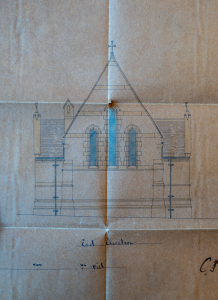
Grove Gardens Chapel
Commissioned around the time of the cemetery extension, Grove Gardens Chapel was the new Church of England funerary chapel for Richmond Burial Ground.
In 1875, it was clear that a new chapel was needed. The original chapel “was built of wood and has become unfit for use”. The estimated cost of this project was £1000 and would be funded by the Vicar and public donations.
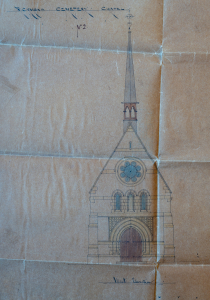
The chapel was designed by Sir Arthur Blomfield (1829-1899), a well-respected ecclesiastical architect who specialised in church buildings. It is in the Neo-Gothic style, made from Kentish ragstone with Bath stone detailing. The chapel originally had a wooden spire but this has since been lost.
It was not just the architect that should be credited with creating the chapel. Several craftspeople contributed their skills to its building:
- Arthur Blomfield (Architect)
- Faulkner Lee (Blomfield’s assistant)
- Joseph Sims (Builder)
- Messrs. Farmer and Brindley (Created the statue of St Joseph of Arimathea which sat in a niche above the west entrance, now lost)
- Mrs. and Miss. Wootton (Created the “very beautiful violet altar cloth”)
- Daniel Bell (Created the mosaic and marble cross and the east window above)
- Messrs. Heaton, Butler, and Bayne (Created a memorial window)
Generous gifts were also donated to the chapel including the altar table (gifted by Mr. Arthur Newton), Mrs. Henry Smith donated the east window as a memorial to her husband, and the Heaton, Butler, and Bayne memorial window was given by Mr. W Blyth.
Grove Gardens Chapel was completed and consecrated in 1877.
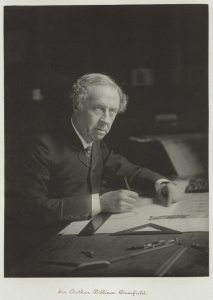
Arthur Blomfield, Architect
Sir Arthur Blomfield was the son of the Bishop of London and was born at Fulham Palace. He was educated at Rugby School and Trinity College, Cambridge. His work can be found in many parts of the country and former British colonies including the Falkland Islands.
Aside from Grove Gardens Chapel, he is also noted for designing the Queen’s School at Eton College, Church House in Dean’s Yard, Westminster, and the Cathedral Library at Hereford, along with buildings at many other schools and colleges, and various works for the Prince of Wales at Sandringham. His most important classical building was designed when he was architect to the Bank of England from 1883 and produced the Law Courts Branch in Fleet Street. He also designed St Barnabas Church in Oxford, in an Italian style.
In 1886 he became vice-president of RIBA (Royal Institute of British Architects). In 1888 he was elected an associate of the Royal Academy, the following year he was knighted, and in 1891 was awarded the RIBA gold medal his distinguished works.
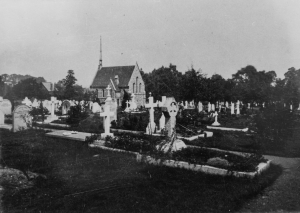
Grove Gardens Chapel in the 20th century
It appears that the chapel was used for regular funeral services without any issues for nearly 50 years. However, by 1928, the condition of the chapel was deteriorating and the local community rallied to get it tidied up.
The campaign was led by the then Vicar, Rev. Harold M. Gray. He wrote notices in the parish magazine and the story was picked up by the local press. One local resident’s letter was published in the Richmond Herald and explained the issues. He wrote:
“I refer to the deplorable condition of the interior of the chapel in the Richmond Cemetery. The altar, bare of any suitable cloth or ornament, with its faded and tarnished hangings, is an eyesore in itself; the altar rails gas standards of handsome design, and brass rods supporting dingy and dirty curtains, are perishing with rust and Verdigris; one of the recesses of the chapel… in which stands a rusty stove, giving out but little warmth has been turned into a receptacle for coal. There are benches for the mourners, of bare white wood, more fitting a village schoolroom than this consecrated building. The worn-out matting on the floor, the dirty mat at the entrance, the outer doors sadly needing paint or varnish and the general want of renovation and cleanliness complete a picture of neglect and decay truly most distressing to see.” – Mr C Capel Smith, 2nd January 1929.
In the Spring of 1929, three main areas of works were identified.
- General cleaning of the interior… fit new gas brackets and burners, re-arrange seating, replace areas of flooring, and find new decorations and curtains.
- Improve the heating by installing gas radiators in the place of the existing stove (tucked away in the south transept) for more efficient heating, greater cleanliness, and save money on fuel and upkeep.
- Minimise the entry of cold air and dust at the west end (main entrance) of the chapel.
With some items donated by the parish, the expected cost was to be between £65 and £100. By 1930, the works were completed at a cost of around £150. The chapel was “now really a worthy House of God, and a fitting place for the last rites in honour of our dear ones, and the new doors and radiators will make it no longer dangerous to mourners during the cold weather.”
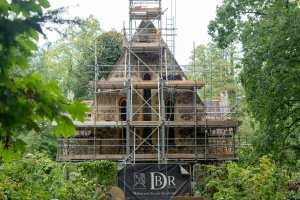
The chapel became disused in 1964 and deteriorated over the following three decades.
Learn more about the conservation and restoration of Grove Gardens Chapel from the 1990s to our recent project that was completed in January 2026.