Natural History and Burton: how he contributed to Britain’s collections
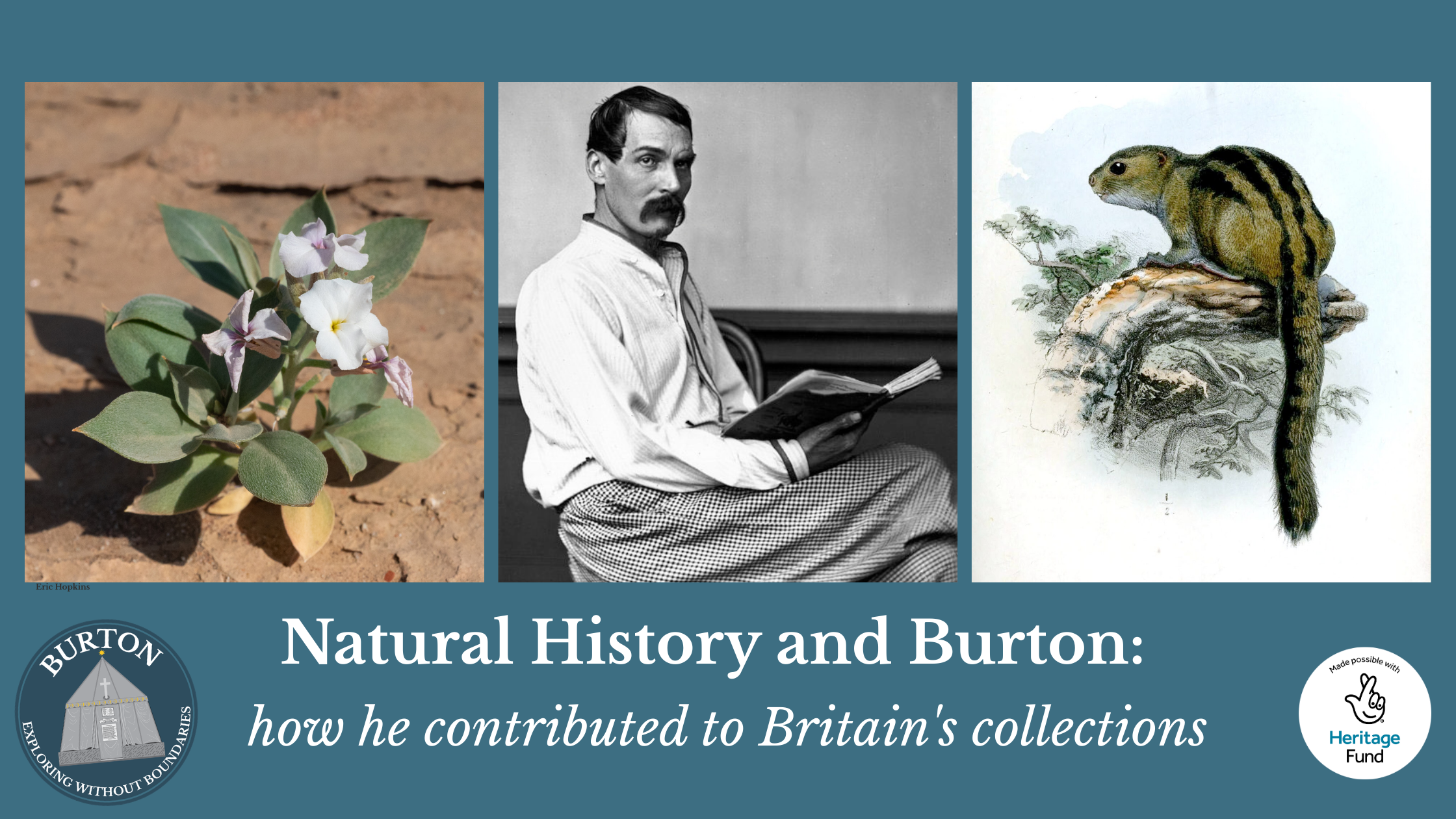
Sir Richard Burton’s detailed accounts of his expeditions capture an in-depth, if bias, record of peoples, geographies, creatures, and flora across lands that Europeans had not previously encountered. This blog posts explores how Burton’s work contributed to Britain’s system of scientific colonisation of the natural world and how, despite this, it can be useful to scholars today.
Empire and natural history collections
Prior to the building of the Natural History Museum (1873-1881), the British Museum housed the nation’s ever growing natural history collection. By 1864 it was essential that a separate building in South Kensington was built to house the then vast amount of taxidermy, skeletons, fossils, gemstones and more, sent to them from around the world. Enabled by global movement throughout the British Empire, the exponentially increasing collection was driven by the Victorian appetite for exploration, curiosity, scientific enquiry, and imperial power.

Natural history collections are often colonial in origin, and there is no question that the size of Britain’s ‘cathedral to nature’ was necessary to showcase the wealth of natural resources and specimens brough to the capital. Efforts to collect species could be disastrous, often with little care for the impact on the locals people or ecosystems. The population of giant tortoise on the Galapagos Islands, already scarce, were decimated by Darwin and his friends, who only managed to bring 4 small tortoises back to Britain out of nearly 50 due to the temptation of the meat. The species are only just recovering nearly 200 years after local extinction.
Specimens were sent by collectors, often via Britain’s trade ships, or brought back after expeditions ready to be given a Latin scientific name and classification. Fauna was sent in skeletal form or already taxidermied, whilst Kew Gardens received plant samples in glass cases or pressed. Botanical exploration and collection was key to Britain’s prosperity, increasing knowledge of useful plant that could be used as fuel, food, medicines and materials. There has been a recent push to decolonise our natural history collections, moving away from the scientific racism of the Enlightenment, acknowledging the provenance of materials and their vernacular names over Western taxonomic systems. However, Victorian records can also support our understanding of botanical histories, changing environments and geographies. The Enlightenment’s dedication to record, facts, measurements and description means that many documents by nineteenth century explorers can help us to assess the impact of climate change and agriculture on global regions.
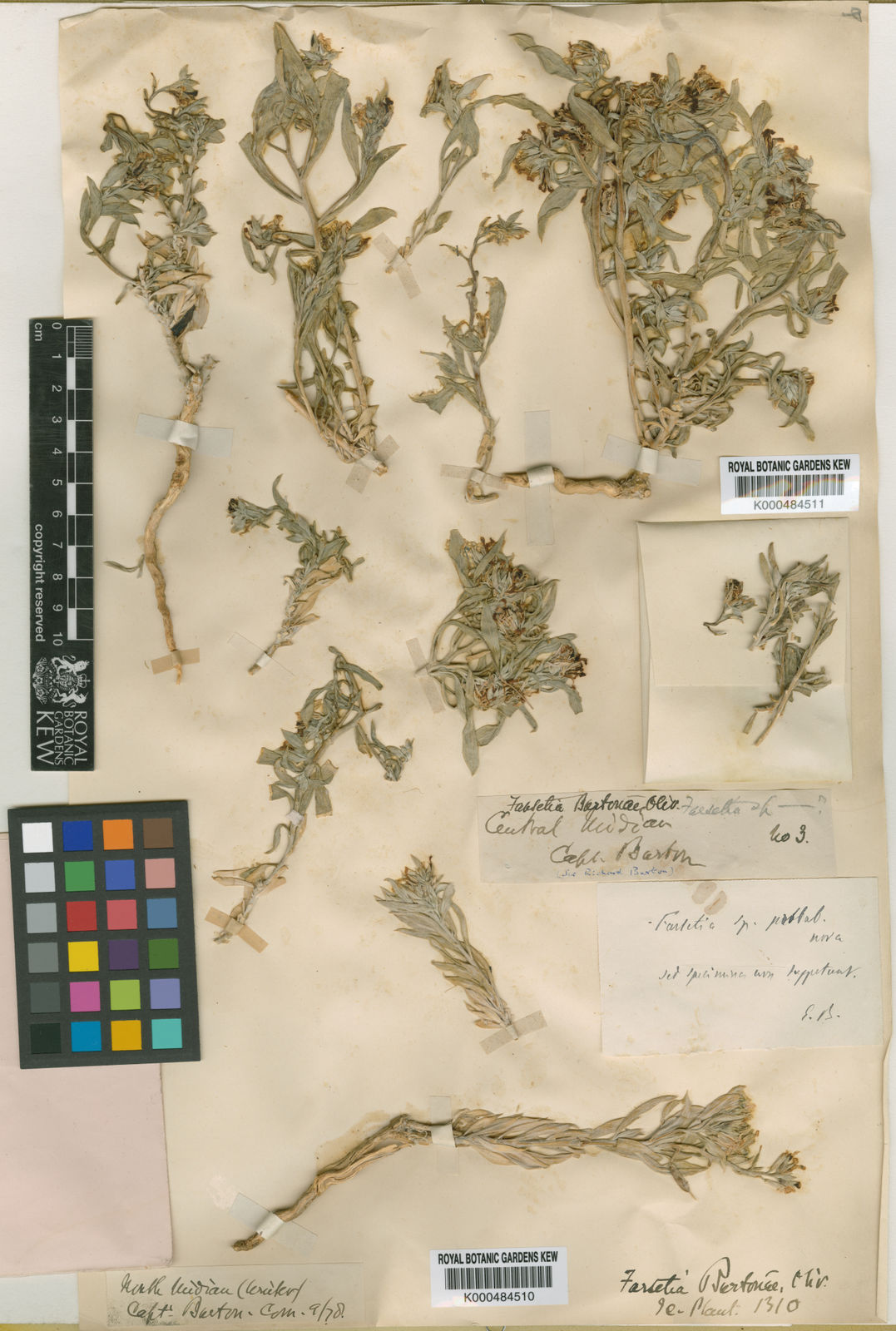
The herbarium at the Royal Botanic Gardens at Kew holds a curious specimen Farsetia Burtoniae, marked ‘Central Midian, Capt. Burton’. Sent to Sir Joseph Dalton Hooker in 1877-8 for identification, this sample was collected by Sir Richard Burton during his expedition to the Madyan, modern-day northwest Saudi Arabia. As a new species to Western science, it was given a latinised name of its collector. Botanist and author Shahina Ghazanfar notes that during this expedition ‘Burton also recorded Arabic vernacular names, uses and ethnobotanical notes, including medicinal and local dietary practices’. His dedication to understanding local customs and language made Burton’s notes particularly accurate and useful as a historical record.
Comparison of Burton’s The Gold-Mines of Midian (1877) and Land of Midian (revisited, 1879) with recent surveys have highlighted ‘both continuity and significant ecological change’ in the region. Whilst many of his records align with UNESCO’s Bioclimatic Refugia of Western Arabia, essential sites for preservation across a spectrum of bioclimates in the Arabian Peninsula, their fragmentation also ‘reflects long-term climatic aridification across Arabia’. Burton’s notes can be used by today’s botanists and scientific community to ‘underscore the ecological significance of the Madyan mountains and the urgency of conserving their unique flora’ (Ghazanfar, 2026).
Cameroon’s Natural History
The specimens recorded and transported by Sir Richard Burton during his expeditions give an insight into what species existed where in the mid-nineteenth century, how collections accumulated in Britain, and what collectors and scientists were looking for. However, they also give us a glimpse of Burton’s perspective, his attitudes and, in some cases, how he used the role of ‘giving names’ to display his own personal affections.
During Burton’s role as British Consul in Fernando Po (now Bioko), 1861-1864, a Spanish island off the coast of Cameroon, he took the opportunity to escape the isolated isle to discover ‘the coast of gold’. Travelling across Ghana, Gabon, Congo, Benin, and Nigeria, many of the surviving records of species collected by Burton come from his expeditions across the Cameroons Mountains, which he recorded in Abeokuta and the Cameroons Mountains: An Exploration (1863). His group for these travels included two missionaries, a government botanist, Gustav Mann, who reported to Sir William Hooker at Kew, and Burton’s steward, Selim Aga.
Aga, born on the edge of the Nuba Mountains, in present day Kordofan, had been kidnapped at the age of eight and sold into slavery in 1836. After multiple owners, he was purchased by Robert Thurburn, a British consul in Alexandria, and sent to live with Thurburn’s brother in Aberdeen where he was freed, christened and educated in the western tradition. Selim went on to write an account of his experiences as a slave, published in 1846, and lectured in London on the Nile. Selim joined expeditions in West Africa in the 1850s, and joined with Burton first in Cameroon and then the Congo.
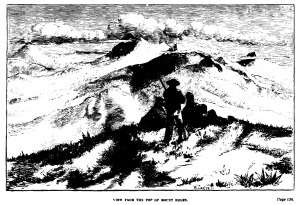
The group’s first action was to name the many peaks of the mountains. Once Mounts Victoria and Albert were chosen and Hooker was given his due, there followed family and friends. Naturally, the men named the peaks after their wives, with Mount Isabel ‘a glorious mass, looming high in the limpid air’. Burton defended the practice of naming of the mountain peaks by claiming the area as uninhabited, unnamed and undocumented, and so necessary to name the area so that followers of their travels could identify their location. This is disputed by Burton’s own work, which accounts for local tribes such as the Bwea people on the east of the mountains. In this case, their attempts to colonise the place names was rather ineffectual as it is a difficult task, over 150 years later, to identify which peaks Burton might be referring to.
‘Even strict geographers cannot blame the act in a place which has absolutely no terminology’
The company did not choose to name any after themselves, but Burton sought out a smaller peak to call Selim. It seems that, despite polygenist attitudes and general contempt of people from the African continent, Burton struck up a friendship with Selim and held him in esteem. Indeed, after Aga’s 1875 memoirs were received with disbelief that an African man could have written them, that they must have been ‘the work of a cultured European’, Burton came to his defence in an article to the Royal Geographical Society.
Aga was responsible for stuffing the specimens, a skill he was taught in Scotland, to send back to London. Small animals were collected either by being shot or caught in a Kruman trap. The Krumans were servants that attended Burton, who disparaged them as mutinous and cowardly. However, they had an ‘ingenious’ method of trapping animals. Burton describes their method of trapping a field-rat, eurotis irrorate, by using ‘a flexible branch, bent to the ground by a cord with a terminal noose, well covered by leaves, and a trigger which is started by the tread when the animal steps inside to eat the grass or grain with the noose.’

A gesture?
Isabel Burton, who was not permitted to join her husband in Fernando Po due to the climate, received parcels of specimens to deliver to the British Museum. These included animals ‘new to science’ a mus, a corcidura and an anomalurus’.
John Edward Gray, Keeper of Zoology 1840-1874, received species that required naming. The Mountain Robin-Chat, or ossypha Isabellae, was named ‘in compliment to Mrs Isabel Burton’. The Pennant-winged nightjar, cosmetornis Burtoni, Thick-billed Seedeater, crithagra Burtoni, Variable Bush Viper, atheris Burtonii, and Burton’s Veli Rat, otymys Burtoni, named after the man who ‘discovered’ them for European science.
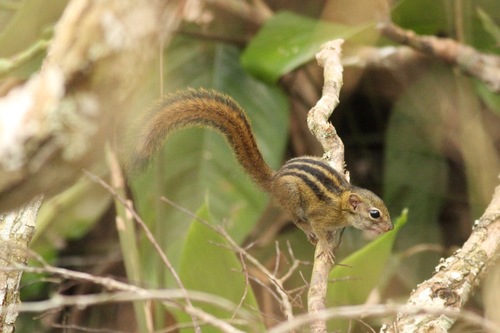
The records shed some light on the kind of relationship that Richard and Isabel shared. In Burton’s instructions to Gray, he requested that ‘any novelty that might be in the list should be so named’ after his wife. In the tropical and subtropical Cameroonian broadleaf and montane forests, lives the funisciurus Isabella – Lady Burton’s rope squirrel.