The Great Stink
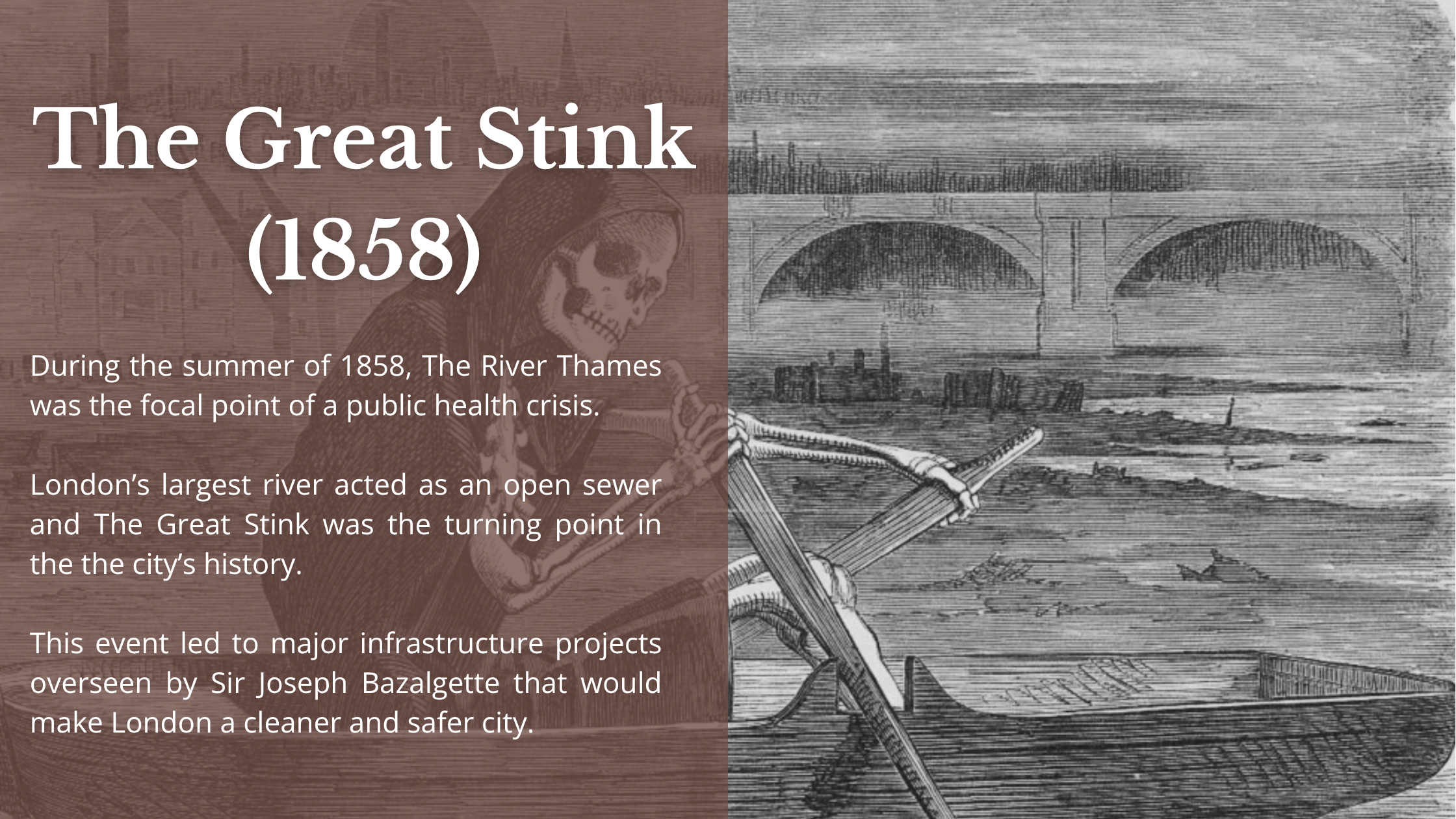
High temperatures and low rainfall were the environmental conditions that led to The Great Stink of 1858. The River Thames had become an open sewer; a dumping ground for London’s domestic, commercial, and industrial waste. The hot summer of 1858 caused the river to fester and ferment. This was the catalyst for change in London’s sewerage system.
The Growing Metropolis: London before 1858
As the Industrial Revolution developed the population of towns and cities grew rapidly. The promise of employment and greater opportunities drove rural people into London, but the existing infrastructure could no longer cope. In half a century the population had tripled and for the poorest of Londoners, living conditions were poor and dangerous.
A lack of clean drinking water, overcrowded housing, and ineffective waste disposal meant that diseases spread quickly and had deadly results.
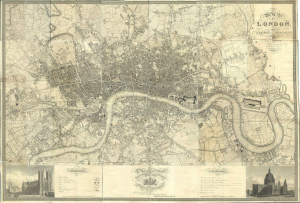
London’s earlier drainage systems were designed to take surface water from the streets and deposit it in rivers. These rivers were tributaries of the Thames which all flowed into the main river. Sewage from buildings was collected in cesspits which would be emptied by nightsoil men and delivered to nearby farms as fertiliser.
As London grew, emptying cesspits became more expensive and farms were no longer withing easy reach. Sir Edwin Chadwick’s famed Report on the Sanitary Condition of the Labouring Population of Great Britain (1842) found that poorer Londoners could not afford to have their cesspits emptied. Similarly, cheap bat guano was being imported from South America and “the market for human waste collapsed” (S Halliday: 1999).
In 1815, the laws that made it illegal to dispose of domestic waste in rainwater sewers were lifted to relieve the pressure on outdated cesspits. In 1840, Thomas Cubitt reported:
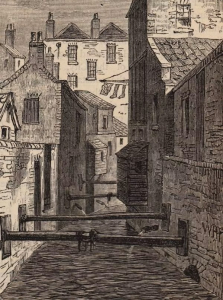
“Fifty years ago nearly all London had every house cleansed into a large cesspool… Now sewers having been very much improved, scarcely any person thinks of making a cesspool, but it is carried off at once into the river. It would be a great improvement if that could be carried off independently of the town, but the Thames is now made a great cesspool instead of each person having one of his own.”
Thomas Cubitt, 1840
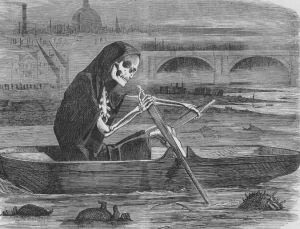
1858: The Great Stink
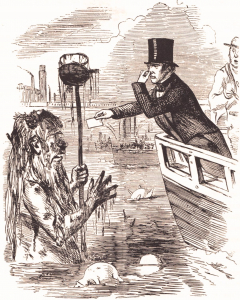
The problem of London’s sewage disposal and the pollution of the River Thames was already well-established by the 1850s. The issue had been discussed for decades with multiple proposals considered and rejected. Only three years earlier in 1855, scientist Michael Faraday had written to The Times warning about the dangers of the river in the event of a hot summer.
From June to August 1858, a long heatwave and little to no rainfall caused the River Thames to become unbearably smelly.
Temperatures remained above 30°C for extended periods, reaching highs of 36°C. These temperatures were well above average, sometimes 12-13 degrees hotter than usual. June 1858 was the hottest month ever recorded.
The raw sewage, animal products, and industrial waste that poured into the Thames, undiluted by rainwater, began to fester and ferment in the high temperatures. The river level also dropped very low and even at high tide parts of the foreshore were visible, albeit under a thick layer of sewage.
Dr Lewis Thomson reported that the temperature of the mud on the banks of the Thames reached 120°F (48.9°C).
On 19 June 1858 the London City Press described the Thames after three weeks of the heatwave:
“It is the receptacle of the excreta of near three millions of persons; dwellings, factories, laundries, streets, pour their liquid and solid refuse into its current; a navy of active steamboats employ their paddle-wheels in stirring the mixture, and the sun – great agent of fermentation – sets the mass into a work, so that from Teddington to the Nore, the Thames breeds pestilence for all who traverse its surface, pass over it, or live within reach of the air that has wafted over its stream of putrefaction.”
London City Press, 19 June 1858
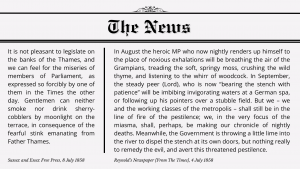
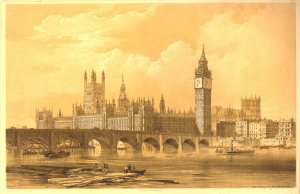
The stink was so bad that the newly built Houses of Parliament were deemed unsafe to work in. The curtains of windows that overlooked the river were sprayed with a chemical mixture in an attempt to counteract the smell.
Not only was the smell an assault on the senses, it was widely believed that bad smells were the cause of illness. The Great Stink was a scary experience, and it was assumed that the stench would cause an outbreak of disease. Only four years before, in 1854, a major cholera outbreak, first detected near the famous Broad Street Pump, killed over 10,000 Londoners.
The Great Stink disproportionately affected the poorest Londoners. While the wealthy could retire to their country estates, and the more comfortable middle classes could take a trip away from the city, the poor had no option but to remain in London. Similarly, the living conditions of working people who lived near the river, particularly towards the east of the city, were very poor.
Finding A Solution
Eleven years before The Great Stink, a Royal Commission was established to look into the state of London’s sewers and make recommendations for improvements. The Commission led to the Metropolitan Sewers Act (1848) and introduced new legislation. It streamlined the organisational process from 1065 commissioners to only 23, introduced laws for new buildings and updating some existing buildings, and greater accountability for people who did not follow the new rules.
Over the years, multiple Commissions, fraught with infighting and disputes, were unable to agree on the best solution. The Second Commission even sent out an open invitation to the engineering community for their ideas, but by the Third Commission all 137 proposals were rejected. The Commissions also faced the issue of limited funding.
On 1 January 1856, The Metropolitan Board of Works officially began work, in place of the previous Commissions. On 25 January, Joseph Bazalgette was appointed Chief Engineer.
Over the following two years, proposals were submitted, debated, and redrawn. Disagreements tended to focus on where the outfalls would eventually sit. The further away the outfalls sat, the more expensive and complicated the building process would become.
1858: Catalyst for Change
The summer of 1858 made the issue of sewage and the Thames an unavoidable conversation in Parliament.
As The Great Stink continued, it was a race to introduce new legislation before the end of the parliamentary session on 2 August. Parliament would not open again until February the following year.
Benjamin Disreili introduced the Metropolis Local Management Amendment Act on 15 July which would give greater powers and funding to the Metropolitan Board of Works to clean up the Thames. The Act was made into law on 2 August after only 18 days.
Aftermath
The Great Stink was the catalyst for radical change for London’s public health infrastructure.
Despite not knowing the true cause of cholera, tackling the smell by removing sewage and other pollutants from the Thames dramatically reduced the spread of water-borne diseases.
The combination of London’s new sewage system and controlling the cleanliness of drinking water, cholera in London was effectively eradicated. The success of this work was demonstrated in 1892 when a particularly infectious strain of cholera was spreading through Hamburg. Hamburn was a large port city and a principal trader with Britain, so the government braced for a major epidemic of Cholera in London, but this did not happen. Bazalgette’s system was working and the disease was kept at bay.
Sir Joseph Bazalgette & The Great Stink of London is a project funded by the National Lottery Heritage Fund, The Rochester Bridge Trust and generous private donations.
Read More
