“Brow of a God, Jaw of a Devil”: Conflicting readings of Sir Richard Francis Burton
by Marina Vitić, Volunteer History Researcher
The only thing certain about Sir Richard Francis Burton is his baffling complexity. He exhibited a multifaceted, varied, and often confusing character both in his person and his work.
The scale of his travels, written works, experiences, ideas and opinions are matched by the equally vast contemporary opinions, biographies, scholarly articles, attacks and conjectural accounts we are faced with today.
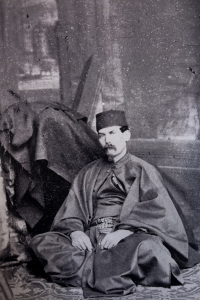
Unpicking the complexity of Richard Burton’s legacy is a daunting task. Invariably he is described as an explorer, scholar, linguist, writer, translator, military officer, diplomat, but also as racist, misogynist, and an agent of the colonial machine.
He has been called provocative, transgressive, inquisitive, as well as disdainful, impatient, and overbearing. This paints a personality that is grand and complicated; a larger-than-life character that attracts attention, both positive and negative. What are we to make of such a person?
Burton was born in 1821 to the family of middle-rank military officer, Joseph Burton, who reportedly fell from favour after refusing to testify against Queen Caroline in her divorce from King George IV. Joseph Burton moved the family to France when Richard was about 5 years old, marking the start of the wanderings, and wonderings that would eventually take him across the world. Richard moved frequently during his early years, living in France, Italy, and England. This constant movement no doubt contributed to his desire to travel and experience life and culture in intriguing parts of the world.
The Burton siblings were initially home-schooled and later attended a local school where Richard exhibited an early contempt for authority in the form of his school master. His rebellious nature was something that he carried throughout his life and career. He took a place at Oxford University in 1840 but was subsequently dismissed for a now infamous steeplechase race less than two years into his degree.
Something of a “vagabond”, Richard appears to straddle multiple identities. He was both agent of the English establishment while acting as an independent “rogue”. He was employed by the East India Company Army and later British Foreign Office while immersing himself in local cultures.
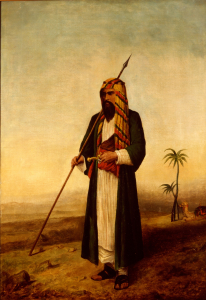
Victorian society viewed him with a certain degree of distrust. His religious ambiguity, moral and sexual curiosity and fascination with “mysterious” culture made him stand out from the crowd. Biographers of Burton have noted that his sharp tongue and outspoken manner may have hindered his diplomatic career. Garth Myers described him as ‘terminally unafraid to assume controversial and outlandish positions on any issue of the day, it is truly amazing that he managed to maintain a Foreign Service diplomatic career for twenty-five years’.
His racial attitudes also made him a controversial figure of his time. The debate around race was a lively one in the second half of the 19th century and fed into political and influential affairs both home and across the Empire. Richard was a founding member of the Anthropological Society of London, an institution that supported the theory of polygenism, the idea that non-white people were a separate, inferior, species of different origins.
The scientific racism of the Anthropological Society of London were not universally approved in Victorian society. An article written in 1863 explained: “we have in London now a Society which seems specially constituted to uphold and sanction slavery; to give it all the weight of science; to insist upon its revival wherever it has died out; and to gather to the side of a wicked and Heaven-doomed system all the restless spirits who are unsettled in their opinions concerning the origin of the human race.”
Despite spending much of his life away from England, Richard Burton continued to participate in cultural and scientific debates there, directing his writing to a domestic English audience and sought institutional approval.
However, many of his contemporaries were baffled by his writing. His work was widely critiqued in the press with a range of reviews from cautious praise to complete condemnation. Everything from his language and writing style, his opinions, and actions, provoked a reaction.
A review in The Examiner of Richard’s Zanzibar (1872) described the work as ‘rambling, egoistical, and excessively bulky’ as well as tiresome, irrelevant and ‘superlatively uninteresting’.
The Pall Mall Gazette review of the same book observed similar faults in the writing and also that Richard had ‘antipathies and prejudices’, was unable to accept criticism, and was generally petty and belligerent to his opponents.
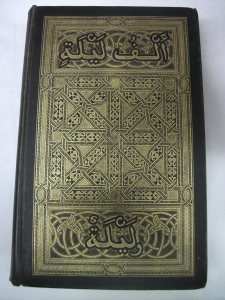
It was not all bad. His translation of The Book of the Thousand Nights and a Night (Arabian Nights) was applauded at the time though modern critics have pointed out how far removed it is from the original. His travel writings were found to be frank, detailed and informative, and ‘scientifically’ impartial, but now seem overly dramatic and exoticized. Meanwhile, some of the topics he wrote about were said to ‘violate good taste’ by Victorian standards. In 1876, Sir Frederic Leighton showed his portrait of Sir Richard Burton, a personal friend, which now hangs in the National Portrait Gallery. The Graphic commended both sitter and artist, and the painting was deemed to be “one of the most vigorous and masculine portraits of the year”.
Since his death, multiple biographies have been published that continue to split opinion about Richard and in recent years, this has evolved into researchers employing various degrees of scepticism to offer new perspectives on his life and work.
Sir Richard Burton’s interests were so broad that it would be impossible to condense all the variables into a finite, neat definition of who he was, or what he can be to us in the 21st century. He seemed to live in a constant state of tension embodying multiple identities and priorities. He both challenged and conformed to Victorian attitudes throughout his life and career.